The example projects
Three example projects come with the editor's source code. Download Source code (zip) from the latest release, unpack it and open a project with File ▸ Open.... Keep each project next to its image.
The sprite art in the examples belongs to its owners and is included only to show and test the editor. See Credits.
Prince of Persia
examples/sgdk/PoP_WW.json is the most complete example: the Prince from a mobile Prince of Persia game, cut into 165 small parts on one sheet, with 207 poses, 68 animations, two mappings and a scene.
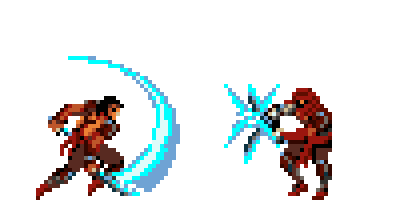
Things to look at:
- Modules: the parts are tiny, often just a forearm or a boot, and Used by shows that many are used in more than 50 frames.
- Frames: turn on Part bounds to see how many parts a pose has, and Budget to see what it costs on a Mega Drive.
- Animations: play C34 Attack, C06 slash or A05 run. Turn on Path to see how a run moves forward.
- Mappings: Normal turns the Prince into a hooded guard. Invizibil swaps 89 body parts for an empty module, so only his swords remain visible. Try both with Preview mapping at the top of the window.
- Timeline: the Swordfight scene, explained in Inside the Swordfight.
Sonic
examples/sonic/sonic.json is a hand-cut Sonic with 65 modules, 38 frames and 171 animations. Open the Animations tab and play through them: it is a good example of how many animations a small set of poses can drive, with holds, offsets and flips doing the rest.
The Auto Modularize guide shows the same Sonic poses as whole sprites, cut into shared parts automatically.
Adventurer
examples/adventurer/adventurer.json is a sheet of whole sprites in 32 by 32 pixel cells, sliced into 68 modules with 15 frames. It has no animations yet, which makes it a good sheet to practise on:
- follow Your first animated sprite to animate its run;
- run Auto Modularize on it and compare the memory before and after.